

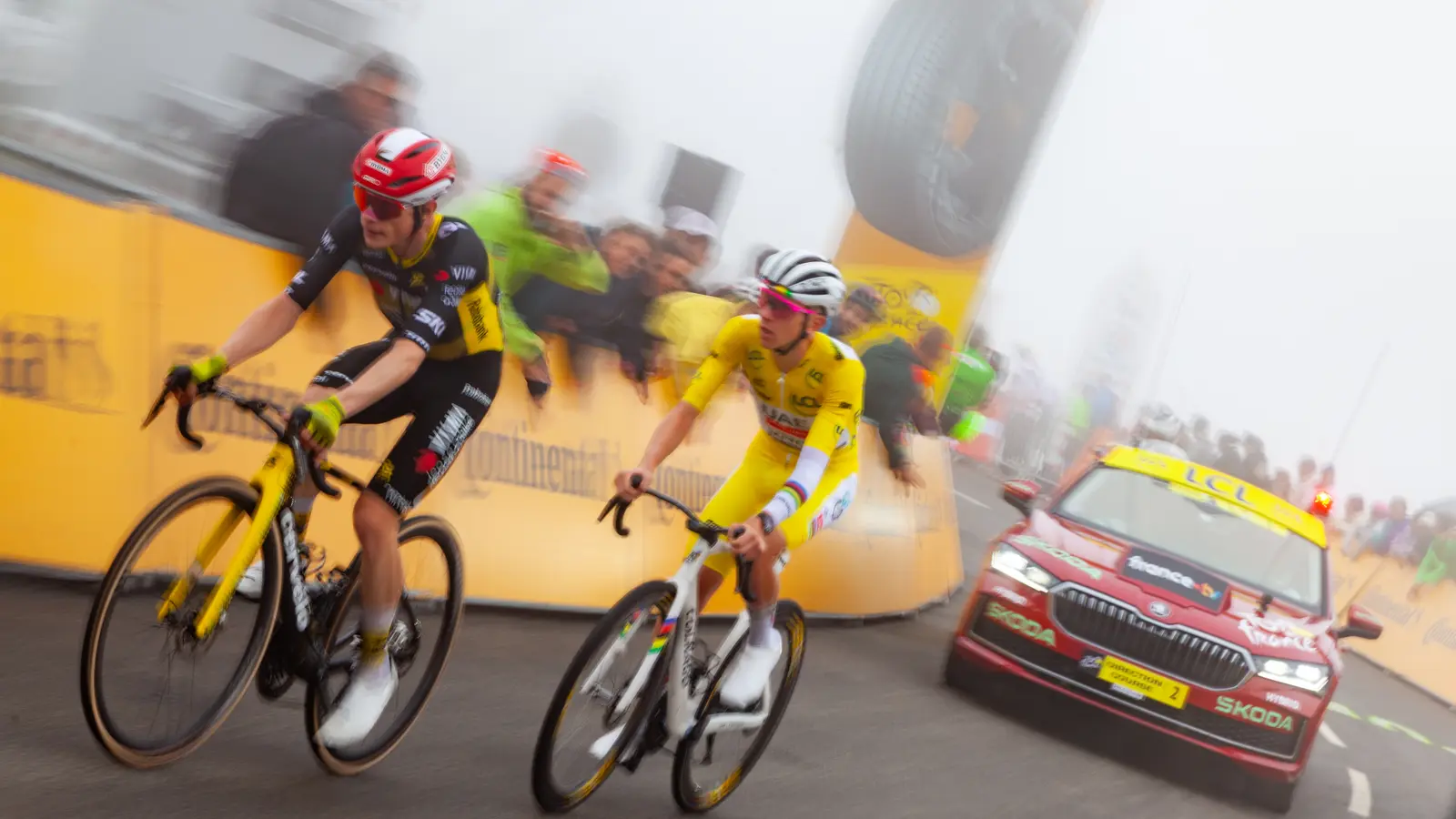

Three contenders, three bikes and three ways to solve the same problem. Tadej Pogačar begins the 2026 Tour on a Colnago Y1Rs with an emphatically aerodynamic profile. Jonas Vingegaard uses a Cervélo S5 whose build prioritises simplicity and low mass. Remco Evenepoel rides the new Specialized S-Works Tarmac SL9, positioned as an all-round racing platform.
It would be tempting to compare three weights and declare a winner. That would be misleading. These bikes were observed under different conditions, with or without accessories, and their setups can change from stage to stage. No controlled test has put all three beneath the same rider with the same wheels and tyres. This is therefore a comparison of documented technical choices, not a fabricated speed ranking.
The setups observed at the Tour start
| Tadej Pogačar | Jonas Vingegaard | Remco Evenepoel | |
|---|---|---|---|
| Bike | Colnago Y1Rs, size 54 | Cervélo S5, size 51 | Specialized S-Works Tarmac SL9 |
| Groupset | Shimano Dura-Ace Di2 | SRAM Red AXS | SRAM Red AXS |
| Crankset | 165mm, 55/40 | 160mm, 52-tooth 1x | 165mm, 54/41 |
| Cassette | 11-36 | 10-36 | 10-36 |
| Wheels | ENVE SES 4.5 Pro | Reserve 42/49 | Roval Rapide CLX III, 51/48mm |
| Tyres | Continental GP5000 TT TR, nominally 28mm and measured at about 31mm | Vittoria, 30mm front and 29mm rear | Specialized Cotton TLR, 30mm |
| Reported weight | 7.07kg claimed by Colnago; 7.25kg measured by BikeRadar | 6.8kg without bottles or computer | 7.0kg |
These rows describe bikes photographed or weighed at one point in time. They are not immutable specifications for the full three weeks. Pogačar's 7.07kg and 7.25kg figures also come from two separately documented builds, not two weighings of one unchanged bike.
Pogačar and the Colnago Y1Rs: aero intent on display
Pogačar's Y1Rs is the most visually assertive of the three. Deep frame profiles, integration and ENVE SES 4.5 Pro wheels make high-speed efficiency an obvious priority. Colnago states 7.07kg for the build presented by the brand, while BikeRadar recorded 7.25kg for the bike it observed. The difference is a useful reminder that total mass depends on size, paint, accessories and the bike's exact state when measured.
A 55/40 crankset paired with an 11-36 cassette gives Pogačar a large top gear without removing a usable climbing range. His 165mm cranks are shorter than long-standing road norms. Shorter cranks can make space between hip and torso in a low position, but the benefit depends on an individual's fit and biomechanics. Copying a number does not automatically make another rider more aerodynamic.
The Continental GP5000 TT TR tyres carry a nominal 28mm label but were measured at roughly 31mm on the fitted rims. That distinction matters when comparing modern tyres: installed width is strongly influenced by a rim's internal width. The Y1Rs is not merely an aero-shaped frame; it is a coordinated system built around position, wheels and tyres.
Vingegaard and the Cervélo S5: 1x, short cranks and low mass
Vingegaard's Cervélo S5 stands out for its 52-tooth SRAM Red AXS single chainring and 160mm cranks. A 10-36 cassette preserves a broad range despite the absence of an inner ring. In principle, a 1x setup removes a front derailleur, one chainring and a shift function: there are fewer parts, no front shift to miss and a slightly cleaner area facing the airflow.
The compromise lies in the spacing between ratios and reliance on one chainring. For a professional who knows the stage profile and has a team car nearby, it can be a tightly focused choice. For a recreational rider crossing varied terrain all year, a double chainset will often offer finer cadence steps and greater flexibility.
Reserve wheels with 42mm depth at the front and 49mm at the rear, paired with a 30mm front and 29mm rear Vittoria tyre, balance stability, aerodynamics and volume. The reported 6.8kg weight is the lowest of the trio, but it was recorded without bottles or computer. It does not prove that the S5 would be lightest if all three were weighed in strictly identical race trim.
Evenepoel and the Tarmac SL9: the middle path
Remco Evenepoel's Tarmac SL9 uses a 54/41 SRAM Red AXS double chainset, a 10-36 cassette and 165mm cranks. His Roval Rapide CLX III wheels pair a 51mm front rim with a 48mm rear, wearing 30mm Specialized Cotton TLR tyres. The observed build was reported at 7.0kg.
This specification does not pursue the same minimalism as Vingegaard's 1x, nor does the frame express its aero intent as loudly as the Y1Rs. It offers two chainrings, a wide cassette and deep wheels: a package capable of covering a fast time trial, a nervous transition stage or a mountain day with limited changes.
Calling the SL9 a “compromise” does not mean it is average. During a Grand Tour, reducing equipment decisions while retaining familiar handling can itself support performance. Specialized also claims an aerodynamic step beyond the SL8, but only matched testing could place that change alongside the two rival frames.
Which bike is fastest? It depends on the scenario
On a fast, flat section, the Y1Rs displays the most overt aerodynamic intent. On a stage where mass and drivetrain simplicity take priority, Vingegaard's observed S5 has clear arguments. For very different stage profiles without a major rebuild, the Tarmac SL9 offers an easy-to-understand balance.
None of those statements identifies an absolute winner. At racing speeds, the rider accounts for most aerodynamic drag. A position that can be held comfortably may erase several frame differences. Tyre pressure and casing, actual tyre width, clothing, helmet and wheel selection also change the result. A rider unable to hold position or cadence on poorly suited gearing will lose far more than the theoretical gain from a profiled tube.
Weight also needs context. The Cervélo's 6.8kg and the measured Colnago's 7.25kg do not necessarily describe the same equipment state. On flat roads, a few hundred grams matter little beside aerodynamic drag. During repeated acceleration uphill, they become more noticeable, but they do not cancel power, pacing or tactics.
What ordinary riders can learn from these builds
The best lesson is not to buy a favourite rider's bike. It is to notice the coherence of each system.
- Start with position. Suitable geometry and a sustainable posture matter more than a theoretically faster frame that causes discomfort.
- Measure tyres after installation. The sidewall number is not always the true width, and frame clearance still needs checking.
- Match gearing to terrain. Vingegaard's 1x is a professional tool configured for a task, not a universal prescription.
- Compare mass like for like. Pedals, bottle cages, computers and paint can easily distort a headline number.
- Leave room for real use. The most effective bike is the one whose ratios, tyres and handling suit most of your rides.
Our verdict is deliberately plural: the Colnago is the most openly aero choice, the observed Cervélo the lightest and simplest build, and the Specialized the easiest to read as an all-round platform. The Tour's stopwatch will judge riders and teams; on its own, it can never be a controlled bike test.
Sources
- Colnago — Tadej Pogačar's bikes at the 2026 Tour de France
- BikeRadar — Jonas Vingegaard's Cervélo S5 at the 2026 Tour
- BikeRadar — Remco Evenepoel's Specialized Tarmac SL9
Archive cover photo: “Jonas Vinegaard and Tadej Pogacar on stage 14 of the 2025 Tour de France”, Skyebble, via Wikimedia Commons, licensed under CC BY 4.0. The photograph is from the 2025 Tour and has been cropped and resized.

 France (fr)
 Belgique (fr)
 Canada (fr)
 Deutschland (de)
 United Kingdom (en)
 España (es)
 Nederland (nl)
 Italia (it)
 Suisse (fr)
