

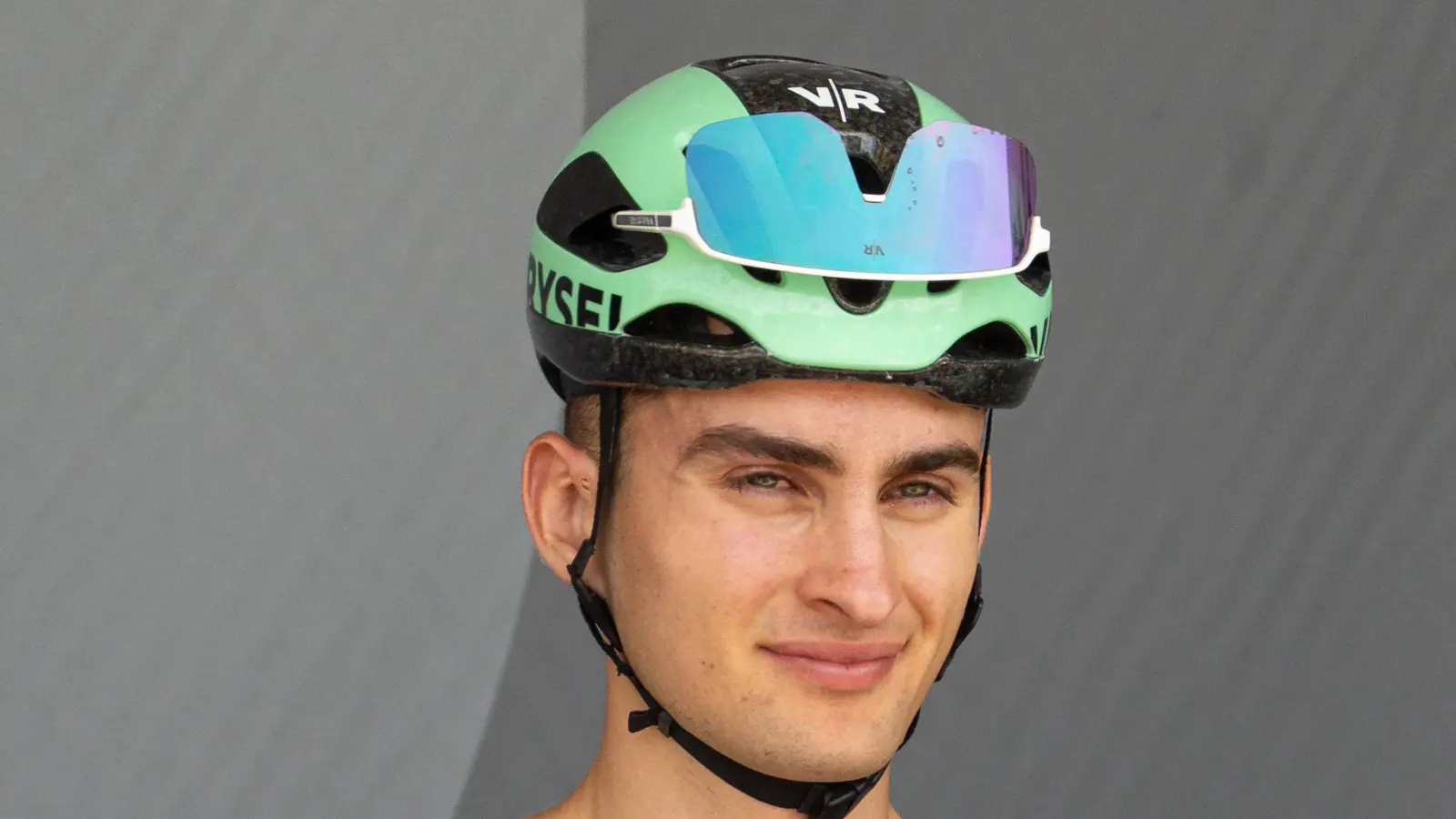

Paul Seixas' new bike attracts attention precisely because it does not fit neatly into one category. Its front section is deep and sculpted like an aerodynamic race machine, while the rear appears markedly slimmer. A phrase on the frame — first seen painted, then in raw carbon during the 2026 Tour de France — summarises the ambition: “Road – Aero – Light”.
It is tempting to infer a name, a weight and a position in Van Rysel's range. The brand has not confirmed those details. We will therefore call it the “Van Rysel prototype”: nicknames circulating online are not established retail names. Here is what the photographs and observed builds allow us to establish, followed by what remains hypothetical.
What we know — and what we do not
| Detail | Status |
|---|---|
| Race use | Observed with Paul Seixas and several Decathlon CMA CGM riders early in the Tour |
| Stated positioning | “Road – Aero – Light” marking visible on the prototype |
| Main frame shapes | Deep front end and fork, slim rear triangle and curved seat tube |
| Observed build | Integrated Deda cockpit, SRAM Red AXS and deep Swiss Side wheels with carbon spokes; crank length not publicly confirmed |
| Retail name | Not announced |
| Frame weight and CdA data | Not announced |
| Price and launch date | Not announced |
| Final production specification | Not confirmed |
That distinction matters. A prototype may use several forks, carbon layups or cockpits during development. The bike eventually sold to customers could differ from the one photographed at the Tour.
A front end shaped to manage airflow
The head tube and fork form the prototype's most expressive area. Their depth and visual continuity suggest work intended to guide airflow around the front of the bike. It is a logical focus: front wheel, fork, head tube and the rider's legs meet in a zone with complex aerodynamic interactions.
The integrated Deda cockpit extends that approach with hidden hoses and a controlled frontal profile. We can describe these shapes as aero-focused; we cannot assign them a wattage saving. No drag figure, wind-tunnel protocol or independent comparison has been published for this version.
That caution does not make the design less interesting. The current RCR-F has a clear aerodynamic brief, while the RCR Pro is Van Rysel's lighter, more all-round race model. The prototype appears to explore a third route: retain a carefully shaped entry into the air without carrying large tube volumes throughout the frame.
A slimmer rear to balance mass and ride characteristics
Behind the bottom bracket, the tubes become visually narrower. A curved seat tube follows the rear wheel, while the seatstays remain discreet. These decisions may serve several purposes: reduce material, manage stiffness or retain an aerodynamic advantage around the wheel.
Those are possible intentions, not measured outcomes. A slim tube does not reveal frame mass, and a visible curve does not guarantee greater comfort. Carbon grade, fibre orientation and internal wall thickness cannot be read from a photograph.
The front-to-rear contrast nevertheless supports the idea of one bike for most stages. For a WorldTour team, reducing platform changes simplifies rider position, spare parts and mechanics' work. For a customer, it could make the choice between speed and versatility easier — if that ambition survives into the production model.
Seixas' setup: a race configuration, not a catalogue spec
The machine observed beneath Paul Seixas combines a SRAM Red AXS drivetrain, one-piece Deda cockpit and deep Swiss Side wheels with carbon spokes. No sufficiently precise public source confirms the crank length, so it should not be treated as an established specification.
The deep wheels reinforce the build's aero focus, but wheel choice can change with wind and stage profile. The same applies to gearing, tyres and accessories. This specification should not be read as a guaranteed parts list for a future complete bike sold by Decathlon.
One report suggested the prototype could come in below 6.8kg before ballast or a configuration adjustment. That is interesting, but not enough to call it a “race bike below the UCI limit”. We do not know the frame size, exact equipment or weighing method behind the number. In competition, the final setup must comply with applicable rules and may use different components.
Will it replace the RCR Pro and RCR-F?
That is the obvious question, and photographs cannot answer it yet. The prototype could replace one platform, combine both or prepare an additional model. The “Road – Aero – Light” marking and hybrid silhouette make convergence plausible, but Van Rysel has confirmed neither a range plan nor a timeline.
RCR-R and RCR-R Pro are already official names in Van Rysel's range, so they do not automatically identify this unnamed prototype. It is equally premature to present it as a “new RCR Pro” or “new RCR-F” without confirmation from the brand.
The missing details that matter most to buyers remain substantial: full geometry, frame weight, tyre clearance, bottom-bracket standard, available cockpit parts, sizing, price and serviceability. Only with those facts can the machine be assessed as more than a fascinating racing tool.
Should you wait before buying a Van Rysel?
If you need a bike now, this prototype does not make the existing RCR Pro obsolete. The current model has known geometry, price, warranty and replacement parts; the prototype offers none of those things to the public yet. A well-fitted, available RCR Pro will always be more useful than an unverified promise of speed.
Waiting can make sense in two situations: your purchase is not urgent and you specifically want the brand's next top-level platform. In that case, watch for an official announcement and compare the production geometry and components, not merely its resemblance to Seixas' bike.
The same logic applies to RCR-F owners. The prototype's front end looks modern, but there is no published evidence that it makes the current bike slow. On the road, position, clothing, wheels and tyres remain major performance levers and may cost much less than a new frame.
Our take: a strong signal, not yet a product
Paul Seixas' prototype is one of the most interesting machines at the 2026 Tour because it gives physical form to the industry's central trend: bringing low mass and aerodynamics into one platform. Its deep front, slimmer rear and top-level race build make a coherent statement of that intent.
Serious analysis must stop where the data stops. We do not know its final name, release date, price or whether it will retain exactly these forms. The Tour provides race-condition development and an exceptional showcase. An official launch must provide the measurements, standards and practical details required for a real comparison.
Sources
- BikeRadar — Paul Seixas is riding an unreleased Van Rysel
- BikeRadar — the new Van Rysel's first appearance at the Tour Auvergne-Rhône-Alpes
- CyclingNews — Paul Seixas' prototype Van Rysel
- Solo Bici / Mundo Deportivo — details observed on the prototype at the Tour
Cover photo: “Paul Seixas on the podium at the presentation ceremony for Stage 5 of the 2026 Tour de France”, Hugo LUC, via Wikimedia Commons, licensed under CC BY-SA 4.0. The image has been cropped and resized.

 France (fr)
 Belgique (fr)
 Canada (fr)
 Deutschland (de)
 United Kingdom (en)
 España (es)
 Nederland (nl)
 Italia (it)
 Suisse (fr)
